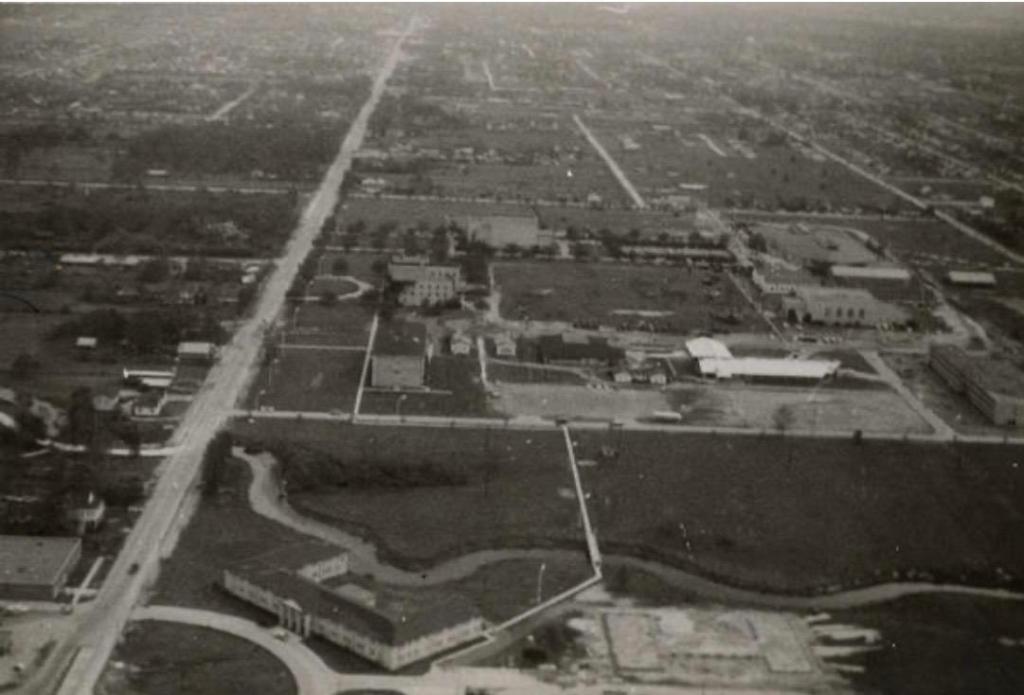
| McNeese from above, 1951 An aerial photograph taken April 16, 1951, shows a young McNeese surrounded by open land. Kaufman Hall, Bulber Auditorium, the Arena, Memorial Gym and the Fine Arts building are visible across a campus far smaller than the one students know today. Taken only 12 years after McNeese opened, the image captures an institution still taking shape. Photo by B.A. Lang Sr. Courtesy of the Louisiana Digital Library, McNeese State University Collection. |
| By Blessing Omoruyi The Poke Press In a 1951 aerial photograph of McNeese State University, buildings are scattered across broad stretches of open land, and roads and walkways connect a campus small enough to take in almost at a glance. The photograph above was taken 12 years after 140 students arrived for their first semester at Lake Charles Junior College, which later became McNeese State University, which celebrates its eighty-seven year anniversary this September. McNeese opened Sept. 11, 1939 in an effort to bring higher education closer to the people of Southwest Louisiana. The original campus was built on land south of Lake Charles that had previously been used as the Calcasieu Parish Poor Farm. Community leaders backed the project after voters approved a $250,000 bond, issued in 1938, allowing federal and state money helped finance the construction. When students arrived the following year, the campus consisted of three main buildings: the structure now known as Kaufman Hall, the Arena and the Auditorium. Kaufman Hall was completed quickly. The construction contract was awarded in December 1938, and it was ready for students nine months later. The cafeteria was not finished, so students and faculty brought their lunches for the first six weeks. Only freshman courses were offered during the first year. Fees were $12.50 per semester, and books were estimated to cost between $12.50 and $25 for the year. By fall 1940, enrollment had climbed to 242 students and the school was renamed John McNeese Junior College of Louisiana State University in honor of longtime Southwest Louisiana educator John McNeese. World War II slowed enrollment growth causing a decline as many students and faculty members entered into military service contracts or took wartime effort jobs. McNeese officially became part of the war effort in 1943, when around 200 Army Specialized Training Program soldiers were housed on the upper floors of Kaufman Hall that had been converted into sleeping quarters. After the war, the institution entered a period of rapid expansion. In 1950, McNeese became a four-year college and separated from LSU. Two years later on May 26, 1952, McNeese State College held its first four-year commencement and 58 students earned diplomas. By that fall, enrollment had reached 993 students, more than seven times the number that had registered when the college opened 13 years earlier. McNeese earned full regional accreditation in 1954. During the same decade, black students challenged the college’s segregation policy. After a federal court ordered their admission, black students registered at McNeese for the first time, broadening educational access to the institution. When Hurricane Audrey devastated the region in 1957, McNeese suspended classes from June 27 to July 8. The Arena and other campus buildings sheltered more than 1,000 displaced people while helicopters carried food and medical supplies and transported survivors from communities farther south. By that fall, enrollment had reached 2,024. New residence halls, academic programs and student facilities followed as McNeese continued to expand. In 1970, McNeese State College officially became McNeese State University. The new name reflected a school that had grown far beyond its beginnings, with expanding academic programs, more students and a campus that continued to fill the open land visible in early photographs. Growth accelerated again in the early 1980s. Fall enrollment rose from 5,391 students in 1980 to 7,017 in 1981. By fall 1983 enrollment had surpassed 8,000 for the first time, with 8,026 students. The decades since have brought new challenges, including economic downturns and major hurricanes, but McNeese has continued to rebuild and adapt. Buildings have been restored, replaced or given new purposes, while new facilities have reshaped the places where students study, meet and spend time on campus. Today, McNeese’s main campus encompasses 122 acres, and the university lists more than 50 buildings across its main campus and related facilities. Three original structures remain visible reminders of where the institution began, Kaufman Hall, the building now known as Ralph O. Ward Memorial Gym and Francis G. Bulber Auditorium. The open fields visible in 1951 became classrooms, gathering places, walkways and spaces used by generations of students. The campus continues to evolve eighty-seven years after those first students arrived. McNeese looks considerably different today as expansions continue on campus. Fall 2026 enrollment stands at 6,663 students, marking the university’s third consecutive year of enrollment growth. |