
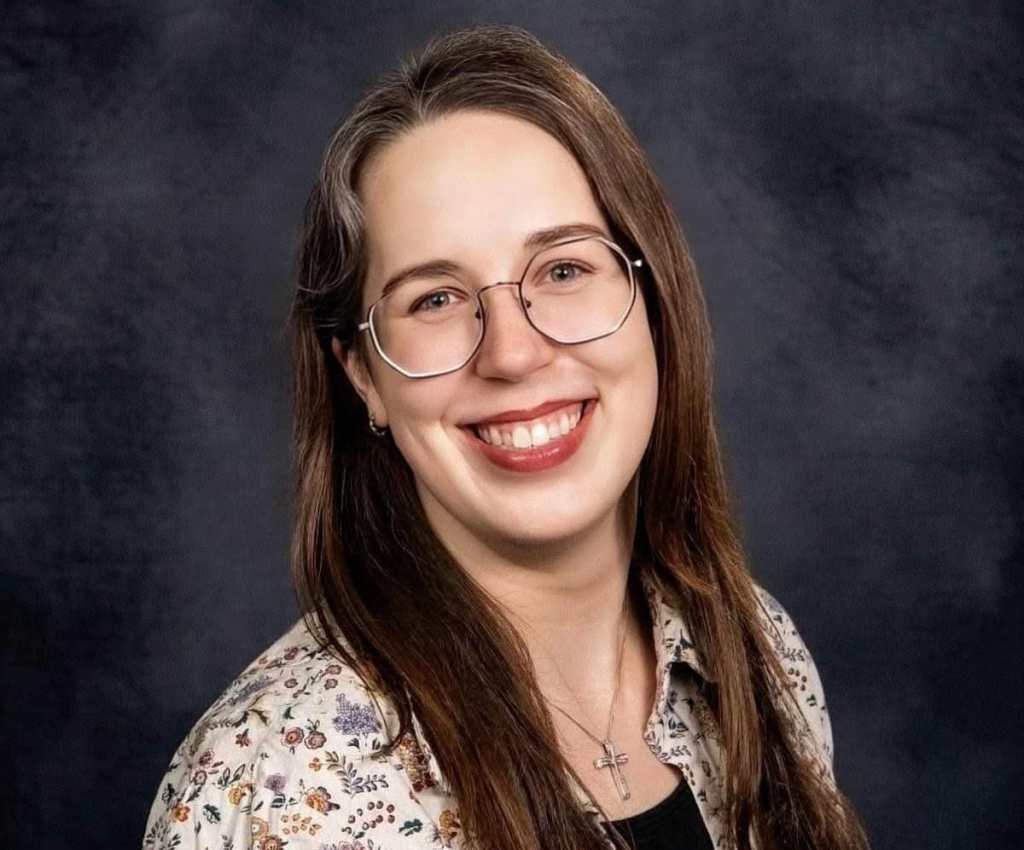
| Submitted Photo of Elizabeth Wroten |
| By Dubem Akukwe The Poke Press Dr. Elizabeth “Ellie” Wroten entered college expecting to become an elementary school teacher. Today, she studies everything from how families adjust when children leave for college to why people form romantic relationships with artificial intelligence. Her journey into academia has been filled with unexpected turns, including learning French to continue another scholar’s unfinished research. Now an assistant professor of family sciences at McNeese State University, Wroten describes herself as a lifespan developmentalist who studies how people navigate changes in their lives and relationships. Wroten began her undergraduate studies at the University of Delaware as an elementary and special education major. She performed well in her coursework, earned high scores on teacher licensure exams and developed lesson plans that impressed her instructors. “People were excited about me becoming a teacher,” Wroten recalled. That changed during student teaching in a third-grade classroom. Wroten recalled working with a student with disabilities whom she was able to connect with and help complete assignments. However, she became troubled when she saw other adults documenting his behavior to support a possible change in his educational placement. She questioned whether his behavior justified the response she witnessed. “What kind of system is this for our children?” she remembered asking herself. The experience led her to change her major to human services, with a concentration in administration and family policy. She initially considered social work and completed an internship helping individuals and families navigate criminal court proceedings. Her plans changed again while completing her undergraduate senior thesis, when her department chair encouraged her to pursue a doctorate. As a first-generation college student, the suggestion caught her off guard. “Ph.D. program? First of all, don’t I have to have a master’s for that? Second of all, don’t I have to be, like, older and wiser?” She recalled asking. Wroten enjoyed research and had already discovered an interest in teaching through her work as an undergraduate teaching assistant. “I liked research. I liked teaching,” Wroten said. “So there are careers that allow me to do that and being a professor is one of them.” She went on to earn both a master’s degree and a doctorate in human development and family sciences at the University of Delaware. She began graduate school in 2021 while raising two young children, an experience she described as challenging but one she would not change. “I can’t imagine having done it without my kids,” she said. “I can’t imagine doing anything differently.” During her master’s studies, Wroten began working with the unfinished research of Dr. Tamara Hareven, a professor of family studies and history at the University of Delaware who died in 2002. Hareven had studied family life and social history, including the experiences of working-class families in the silk industry in Lyon, France. Her unpublished interviews were preserved among research materials that Wroten later encountered. Wroten described the collection as a “literal treasure trove,” but there was one problem: The interviews were in French, a language she did not speak. When she could not secure funding for a translator, she decided to learn French herself. For approximately eight months, she immersed herself in the language, listening to French music, practicing vocabulary and watching television shows. She even watched Jane the Virgin and read the Harry Potter series in French. The effort allowed her to translate and analyze six previously unpublished interviews for her master’s thesis. Wroten published an initial study and continues working with the remaining materials, which she hopes could eventually become a book. But the experience also raised another question for her. “How do academics handle unfinished projects?” Wroten asked. “Do we make plans for things if we die?” Those questions helped shape her doctoral dissertation, Retirement, Death Attitudes and Legacy Planning Among Senior Academics. Through interviews with academics approaching retirement, Wroten examined how they viewed their professional identities, thought about death and planned for the research they might leave behind. She found that many participants strongly identified with their academic work but had given relatively little thought to what would happen to unfinished projects after their deaths. “By and large, we really don’t plan on it,” Wroten said. “But we very strongly identify with our identities as academics.” The project also developed her interest in thanatology, the study of death and dying, one of her areas of specialization. Wroten’s research extends beyond retirement and death to other changes people experience throughout life. Through her work with the LAUNCH research lab, she has studied how families adjust when young adults leave home for college and become more independent. One concept she explores is ambiguous loss, which can describe feelings of loss when someone remains emotionally important but is no longer physically present in everyday life or physically present but psychologically absent. Wroten recalled parents who closed their children’s bedroom doors after they left for college because seeing the empty rooms was difficult. But not every family experiences the transition the same way. Some parents welcome the distance, particularly after periods of conflict or the stress of college applications. Others look forward to developing a different relationship with their children. “It’s just a different time for the relationship,” Wroten said. “It’s a different time for that person to develop their identity and grow into who they are going to become.” Her work also examines emerging adulthood, a developmental period generally associated with ages 18 to 29. At 28, Wroten joked that despite being married, raising children, earning three degrees and teaching college courses, she does not always feel like she has figured out adulthood. “There are times I come to work and I feel like I’m cosplaying as an adult,” she said. Wroten’s interest in relationships has also led her to study the connections people form with artificial intelligence. Working with researcher Genesis Clayton and other collaborators, she has conducted interviews and surveys involving people who form friendships or romantic relationships with AI companions. Their research explores what motivates people to pursue these relationships and how they experience emotional connections with artificial partners. Wroten described participants who created AI companions modeled after fictional characters, former romantic partners and people they had encountered in real life. In one interview, a participant described creating an AI companion modeled after a married woman he had met through his work as a mechanic. The account raised questions about how people use technology to explore connections they could not pursue in real life. For Wroten, the project also reflects her commitment to helping students develop as researchers. She explained that part of her motivation for working on the AI studies was supporting Clayton, who was a graduate student at the time. “Mentorship is a cornerstone of what I do,” Wroten said. “Again, paying it forward. How do I help the next person?” That approach reflects her own experience as an undergraduate, when a professor encouraged her to pursue a career she had never considered. Although she decided against elementary school teaching, Wroten discovered through her work as a teaching assistant that she enjoyed working with college students. She even held a position in a physics department, helping students complete laboratory assignments and solve equations. “I liked being in the classroom,” Wroten said. “I liked engaging with students at the collegiate level.” At McNeese, Wroten teaches courses in human development and family sciences to students from different majors and age groups, including adults returning to college later in life. She said her research helps her better understand some of the experiences students may be navigating, from family relationships to growing independence and decisions about their futures. Wroten also hopes to provide students with the encouragement and research opportunities that helped shape her own academic journey. “I have had the privilege of getting so much knowledge,” Wroten said. “And it’s irresponsible to keep it to myself.” |

Leave a Reply