
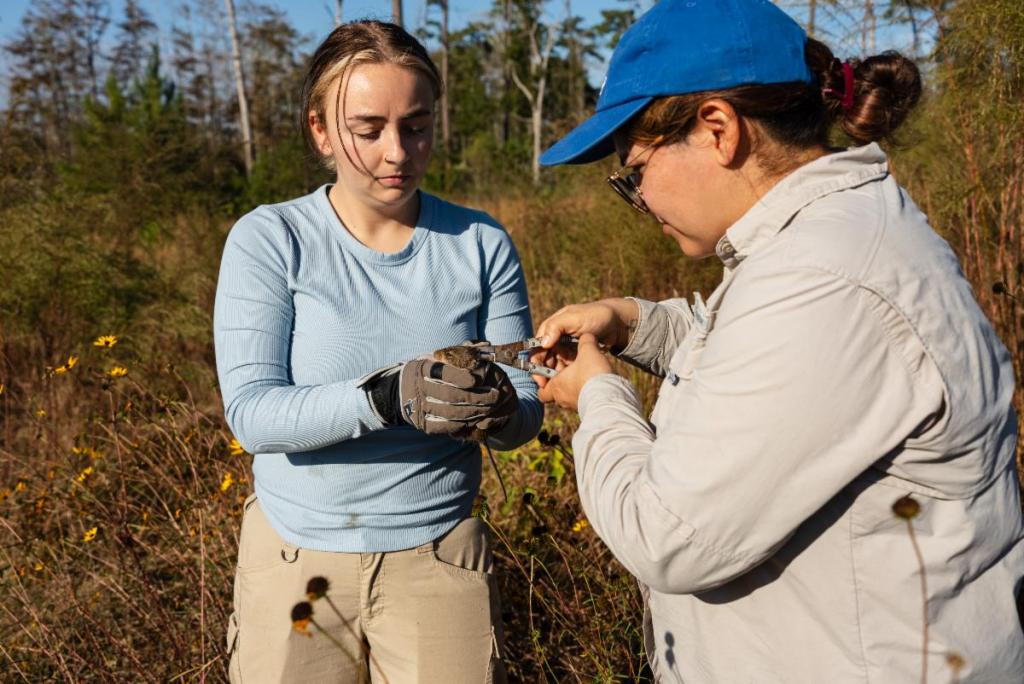
| Photo courtesy of McNeese office of Marketing and Communications From the left: Celise Crenshaw and Diana Roda tagging the ear of a cotton rat that was captured in a trap before releasing it. |
| By Dubem Akukwe The Poke Press Two McNeese State University graduate students are conducting wildlife research at Sam Houston Jones State Park as part of a five-year environmental restoration project funded by Woodside Energy. The project brings together habitat restoration by Resource Environmental Solutions, or RES and biodiversity monitoring by McNeese researchers. While RES works to restore the park’s habitats, the university’s team is studying reptiles, amphibians, bats and small mammals to understand how wildlife populations change throughout the process. Much of the fieldwork is being carried out by Celise Crenshaw and Diana Rodas, graduate researchers pursuing master’s degrees in environmental and chemical sciences with concentrations in integrative biology. Both began working on the project this fall and expect to graduate in 2028. Rodas monitors reptiles and amphibians, spending hours checking cover boards placed throughout different habitats in the park to provide shelter for animals seeking protection from cold temperatures or dry conditions. “We spend a good chunk of our morning, a couple hours at least, checking each individual cover board to see if there are any reptile or amphibian species underneath,” Rodas said. Crenshaw’s work involves monitoring bats at night and trapping small mammals during field visits. “For the bats, we go out to a location and set up these mist nets, which are long nets with little holes in them over water so that when bats come down to drink, they’ll get caught in the net,” Crenshaw said. Their work helps researchers document the diversity and abundance of animals encountered at different locations throughout the restoration project. Justin Hoffman, a professor and assistant head of McNeese’s biology department, said the university became involved after a RES manager who graduated from McNeese contacted his former professor, Eddie Lyons, now executive director of the William J. Doré Sr. School of Graduate Studies. Lyons then contacted Hoffman and Sarah Baker, an associate professor in the biology department, about involving McNeese in wildlife monitoring. Of the approximately $5 million allocated to the restoration project, about $300,000 is designated for McNeese to cover graduate student salaries, equipment and other research expenses. Because the restoration is still in its early stages, the team is documenting the wildlife currently present to establish records that can be compared with future observations. “We are in the very, very, very beginnings of data collection,” Hoffman said. The monitoring will also continue beyond Crenshaw’s and Rodas’ time at McNeese. Hoffman said another pair of graduate students is expected to take over after the first two and a half years, allowing the university to collect wildlife data throughout the five-year project. For Crenshaw and Rodas, the project provides field experience in areas they hope to pursue professionally. Crenshaw said she is interested in continuing work in restoration and conservation, while Rodas was drawn to the project because it brings together several areas of biology. “What attracted me to the project in the first place is, like, how interdisciplinary it was,” Rodas said. “So there’s, like, restoration ecology, and then there’s herpetology, and then there’s, like, even conservation biology in play.” Rodas said she hopes to continue studying those fields, potentially working in environmental project management or conducting field research for a nongovernmental organization or federal agency. The project also offers research opportunities beyond the two graduate students. Baker said the funding supports graduate research and allows undergraduates to participate. “We can give good stipends to students to come in and get research done,” Baker said. “So having a really well-supported, structured project like this also gives the opportunity for the undergraduate students to go and assist the grad students, work with them on their own small projects, and it gives us more options for what we can do with our research time here.” |

Leave a Reply