
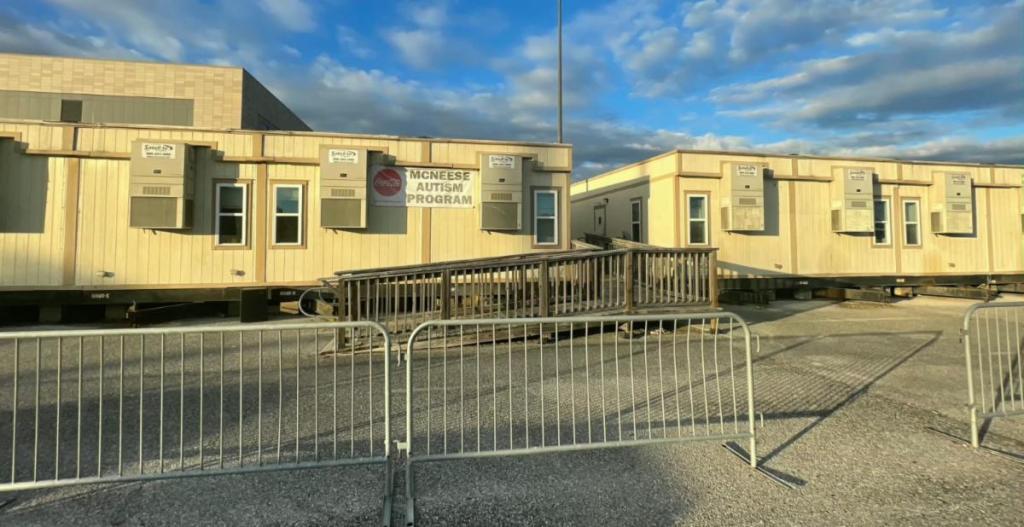
| Temporary trailers behind Navarre Stadium have housed the McNeese Autism Program since the 2020 hurricanes.Photo by Annabelle Loupe |
| By Dubem Akukwe The Poke Press Behind Navarre Stadium at McNeese State University, a series of temporary trailers houses a clinic where graduate students receive professional training while providing care and support to children with autism in Southwest Louisiana. 4tgh Established in 2008, the McNeese Autism Program serves as the clinical training site for students pursuing a Master of Science in Applied Behavior Analysis. According to Brandi Cart, operations director of the McNeese Autism Program and the Kay Doré Counseling Clinic, McNeese’s graduate program in applied behavior analysis has been the only graduate program in Louisiana accredited by the Association for Behavior Analysis International since 2013. Cart said the Autism Program was among the few providers of autism services at the time of its establishment. Over the course of its history, the program has employed dozens of board-certified behavior analysts, or BCBAs, professionals who assess behavioral needs, develop individualized treatment plans and oversee the delivery of behavioral services. These professionals have provided care to the community while training future practitioners in the field. Since its accreditation in 2013, the graduate program has produced 90 graduates. Twelve graduate students currently train at the clinic, four of whom are expected to graduate in December. The clinic currently serves children with autism ranging in age from 5 to 9, including children who are nonverbal and those who require support with significant behavioral challenges. Cart said some of the children served by the program have difficulty accessing care elsewhere in the community, whether because of waiting lists or differences in the types of services other clinics provide. “If you have a child with an autism diagnosis with aggression, severe behavior and things like that, we can be a place to fill that gap when maybe other facilities in the community can’t fill that need,” Cart said. Graduate students work under the supervision of a BCBA, gaining the fieldwork experience and competencies required to complete their degrees while working toward becoming board-certified behavior analysts themselves. “These graduate students, those are our interns, they’re learning from a BCBA how to be a BCBA, and they’re also providing services to these children,” Cart said. Families seeking services through the clinic are placed on a waiting list. When openings become available, the clinical team reviews the needs of children on the waiting list, considering the types of care the clinic can provide as well as its role in preparing graduate students to work with children with varying needs. Families identified through this process are contacted for an assessment. Based on the assessment, the BCBA develops a treatment plan outlining the areas in which the child needs support and the number of hours of therapy the child will receive each week. In addition to training graduate interns, the program employs undergraduate students and trains them to become registered line technicians. Both graduate interns and undergraduate technicians work directly with children during therapy sessions. Cart said the clinic works around students’ class schedules and teaches them skills that can be applied to careers outside applied behavior analysis. “So if you’re going into education, or you’re going into nursing, or you’re going into anything where you might encounter children, this is a transferable skill set,” Cart said. The clinic currently employs eight undergraduate students, with hourly wages starting at $10 during training with the potential to increase to as much as $15. The clinic generates its own revenue to cover employee salaries, materials used during therapy sessions and other supplies needed for its daily operations, while the university provides facilities, maintenance and custodial services. The program was previously housed in Farrar Hall, which was destroyed following the 2020 hurricanes. It has since operated out of temporary trailers behind Navarre Stadium. Renovations are underway at the former University Police building on Ryan Street to provide the program with a permanent home. The facility will include 16 individual session rooms, two group session rooms, a conference room, an intern training room and a sensory room. By its expected completion in spring 2028, the program will have spent approximately eight years operating from temporary facilities. Cart said the new facility will allow the clinic to serve more individuals and expand the types of services it offers to people with neurodevelopmental disabilities. “So our clinic really is a value to the community and McNeese as a whole, in the way we’re supporting the academic program, the way in which we’re supporting undergrad, and the way we’re supporting the community,” Cart said. |

Leave a Reply