
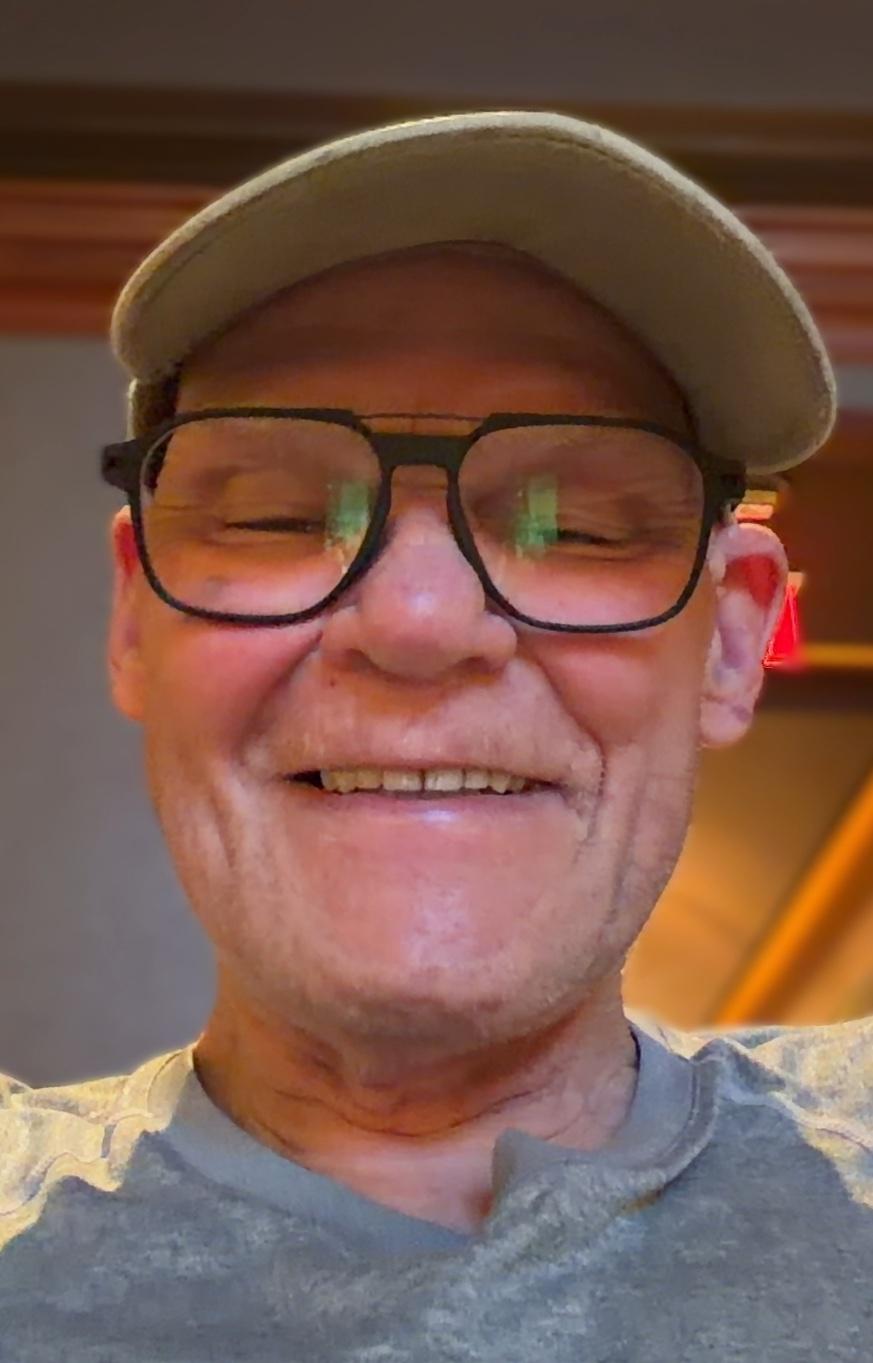
| FaceTime Photo of James Carville, November 13, 2026. Photo by Kelly Richard |
| By Kelly Richard Faculty Advisor, The Poke Press Thanks to my colleague, Tryfon Boukouvidis, a mass communications instructor at McNeese, I got the opportunity to interview James Carville for The Poke Press Nov. 13, just 10 days after the historic midterm elections. If you don’t know who James Carville is, he is one of, if not the most influential political strategists of our time, so landing this interview was nothing short of shocking. With that being said, I knew I could search and easily find his opinions and predictions on most major news outlets for almost any current political question I could think to ask him, so I didn’t. Instead, I asked him about his college years, communication and the democratic process, how young adults are discouraged at the idea of being able to afford to buy a house, racism and what advice he has for the next generation. At 82, Carville, known as the “Ragin Cajun,” a moniker given to him in the ’80s referencing his combative and often controversial communication style, continues to dominate the talking points when it comes to politics, something he’s done for nearly 50 years now. You could say he is the OG influencer of modern media. He himself has been described by industry professionals as a “multimedia corporation,” and “a walking conglomerate.” His continued media influence as an octogenarian and his ability of remaining relevant is unique, especially by today’s standards. Along with six siblings, James Carville grew up in a catholic family in Carville, La., and served as an alter boy. He attended Louisiana State University for his undergraduate studies and struggled as a college student, reportedly earning 56 F’s and flunking out. He spoke of his challenges with dyslexia and the advantage of having ADHD, which he sees as a superpower. “I can’t focus on anything too long, it’s perfect for political ads.” He enlisted in the U.S. Marine Corp in the late ’60s around the time of the Vietnam War. “I knew I was going to be drafted anyway, so I figured I’d get it over with.” After two-years of service and earning the rank of corporal, he returned to college on the GI bill, attended night school and earned a bachelor of general studies and later a juris doctorate at LSU. We spoke about the challenges facing college students today and he made it clear how different the circumstances were when he was in college. “Times were so different then, I mean, I think tuition was something like $100.” After college, he joined Weill-Strother, a political strategy firm, and kicked off his career in politics. He recalled those early years working on campaigns, initially losing many of them, which made him so driven to win. He went on to work on numerous gubernatorial campaigns in Louisiana and really rose to fame when he was hired to assist then Governor of Arkansas, Bill Clinton, on his presidential run. Throughout his career, he has worked on campaigns in 23 different countries and when asked about foreign influence on today’s elections and the parallels to his involvement on international campaigns, he said, “I guess it’s no different.” He said it all comes down to being able to craft a message that resonates. In the early 2000’s, Carville returned to college, this time as faculty, teaching a variety of communication and political science courses at North Virginia Community College, Tulane University and LSU’s Manship School of Mass Communication. His advice to college students today, “Be willing to fail and don’t let anyone else dictate what you are capable of. You have to believe in yourself; you’re only as good as you think you are.” He recommends all college students take two courses, one on comparative governments and one on the Old Testament. He stated that the Old Testament is the “foundational document of political strategy … it has all the components, betrayal, false leaders.” In addition to campaign consulting, he has worked as a media anchor for CNN, been a contributor for Fox News, served as an executive film producer, a podcast host, authored numerous works on topics ranging from politics to his personal life, some of which he co-authored with his wife who is also a political strategist on the other side of the isle, and even penned a Louisiana based children’s book. His public influence has been seen in advertising campaigns for Coca Cola, Nike, Maker’s Mark, American Express, Heineken, Playboy, Little Debbie and Captain Morgan, among others. You could say he is a communication jedi and a leading expert on messaging. When asked about misinformation and whether the truth in media matters anymore, he said, “Yeah, I guess it does, but repetition works. Look, if you betray someone, tell them something that not’s true, they will find out, and they get angry. They will turn on you.” When talking about the housing market, NDAs and banning press from the white house, he repeatedly referenced the Old Testament, stating, “the lessons are all there.” He described what he considers to be “the greatest con job in American history,” referencing the financial housing crisis that caused the market to bust. “And not one single person went to the penitentiary, ha. The banks were left holding the bag.” Following that he pitched the idea of holding those responsible for the housing crisis accountable, possibly setting up a penalty fund to help young first-time home buyers in coming up with a down payment for a house. “Young people today have a healthy skepticism of power, for good reason. Power LOVES darkness.” One of the biggest take aways from the interview was on the topic of racism. He said “young people are not born with it, it’s introduced later.” He went on to say how younger generations today have friends of all kinds, races, economic backgrounds, etc. stating, “that’s how it should be.” He reflected on an important lesson he learned from his kids, sharing a time he pointed out someone’s sexuality when describing them. “I referred to someone as gay, like I would if I were saying they had blond hair, or blue eyes and it was pointed out to me that it wasn’t right, and right then I realized how stupid that was, how stupid I sounded.” He shared great pride of his Cajun ancestry, spoke of the exile and resettlement of the Cajuns in Louisiana, and bragged on how inclusive and open minded the Cajun people are and the importance of preserving that culture. He reminisced on his time spent hunting and fishing in Pecan Island, the proposed site of a new SpaceX launch facility on the coast of Louisiana, saying he’s been fortunate enough to spend some time there. He said, “they’re destroying our land, they’re destroying our culture.” His final advice to young adults was this, “It’s your say. You can demand not to pit people against one another!” The purpose of this piece was not be political, but to introduce one of the greatest strategic minds to the next generation of young people. Love him or hate him, he is a legend in his own time and has something to teach us all. |





Leave a Reply