
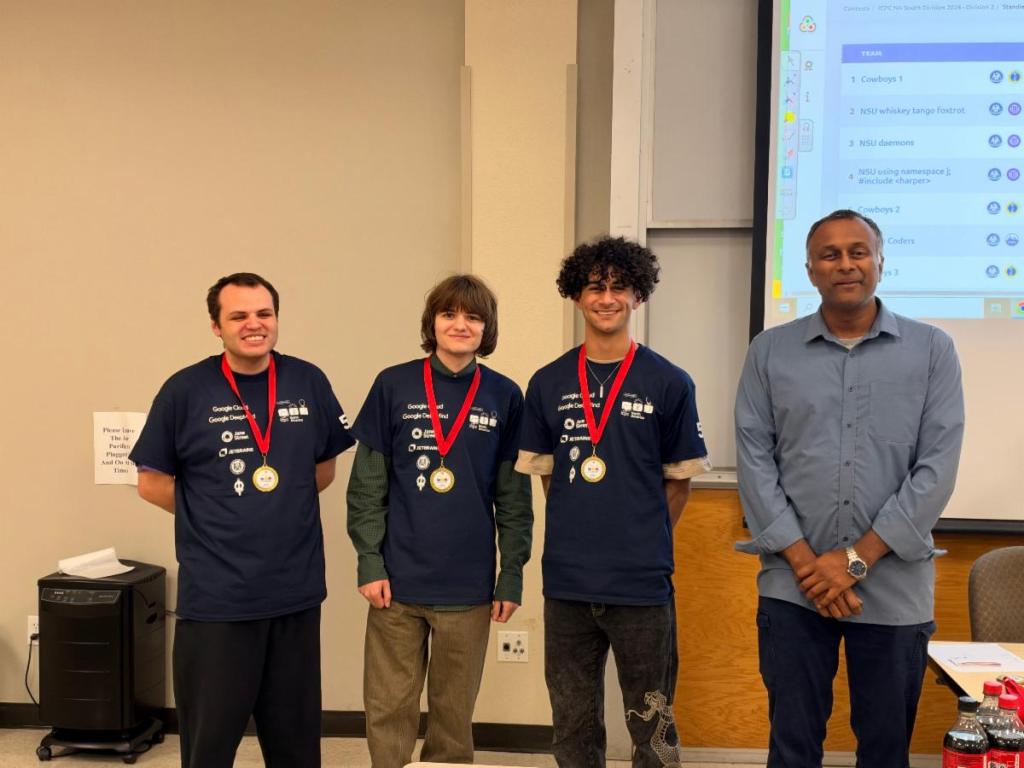
| From the left: Evan Weber, Cooper Tadlock and Dylon Gradney stand with programming coach Vipin Menon after earning Division II gold at the International Collegiate Programming Contest on Nov. 7 |
| By Prince Omoruyi The Poke Press When Evan Weber, Cooper Tadlock and Dylon Gradney opened their contest packet in Hammond, they had 13 programming problems, five hours and one computer. They started by looking for a problem each teammate knew how to tackle. By the end of the afternoon, they had solved six and earned Division II gold. Competing as McNeese Cowboys 1, the three finished first among eight Division II teams at the Southeastern Louisiana University site of the International Collegiate Programming Contest on Nov. 7. Of the nine McNeese students who competed, Weber said he was the only one who had entered the contest before. The team began preparing nearly a month in advance. Every Tuesday and Thursday, Weber, Tadlock and Gradney met for two to three hours to work through programming problems. Weber, a senior majoring in cybersecurity and the treasurer of McNeese’s Association for Computing Machinery, or ACM, chapter, said he made a point of finishing his classwork early so he could devote that time to practice. On contest day, the team had no assigned roles. Each student looked through the packet for a question he could solve or had an idea how to approach. “Then, once someone found a problem, we’d let our other team members know which question they were solving, so no two people were working on the same question,” Weber said. About halfway through the contest, a problem changed hands. Tadlock, a sophomore computer engineering major, had gotten stuck and set it aside for his teammates to look over. “While Evan and I solved another problem, Dylon came up with a solution and scored an extra point for us,” Tadlock said. To earn credit, teams had to write and test a program whose output matched the judges’ expected output exactly, according to Vipin Menon, the team’s programming coach and McNeese ACM advisor. Menon had taught all three students and said watching them work together during informal practice sessions gave him confidence in their chances. “Their hard work, natural problem-solving ability and attention to detail made the biggest difference,” Menon said. Weber was more surprised by the result. Other teams had spent longer preparing and had more competition experience, he said. For him, the medal reflected the hours the three had carved out of busy schedules to practice. For Tadlock, who entered with his friends to see how they would do, the most memorable part was trading ideas and seeing a teammate find a solution where he had been stuck. Menon also recognized the six other students who represented McNeese in Hammond: Rohit Yadav, Rohitpreet Singh, Hunter Liles, Akash Patel, Prashansa Jha and Utsab Adhikari. Back on campus, the ACM chapter has a study lounge in Drew Hall where students meet to work on problems together. Menon said Weber, Tadlock and Gradney are already sharing tips with other computer science students, some of whom could be opening their first contest packet next year. |

Leave a Reply