
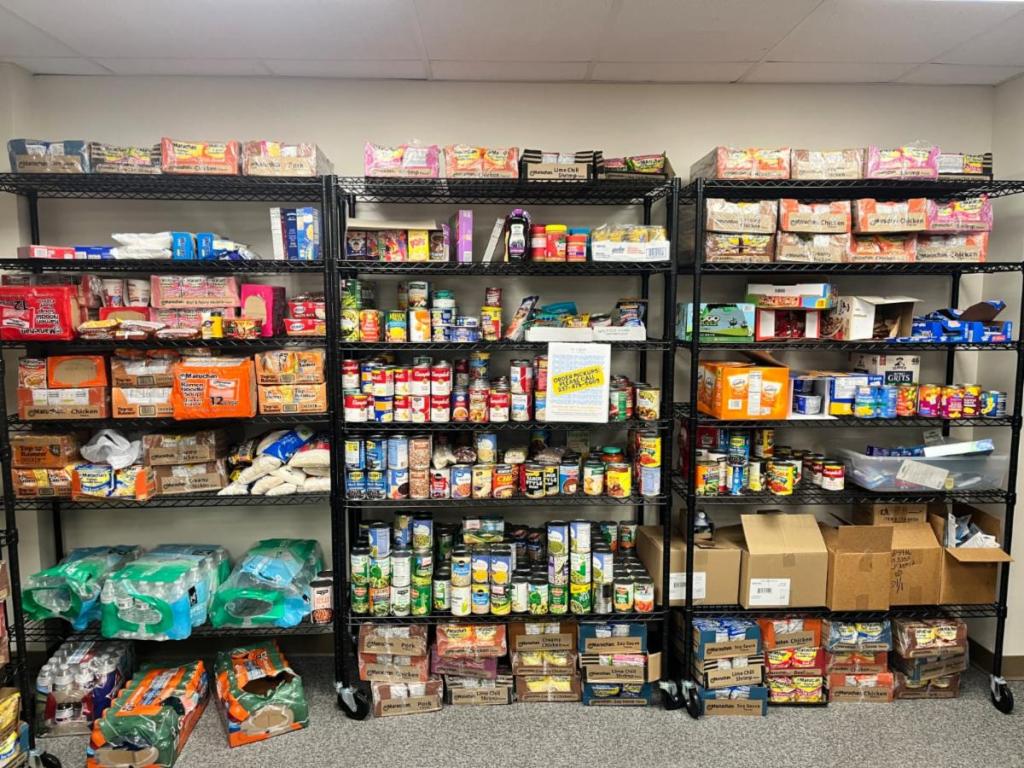
| Picture of the Poke Pantry which has been stocked with donations from Hunger Week.Photo by David Mbagwu |
| By David Mbagwu The Poke Press McNeese’s First Hunger Free Campus Week Highlights Food Insecurity Among College Students McNeese State University is bringing attention to the issue of food insecurity through its first Hunger Free Campus Week, held Nov. 17-20. The initiative aims to raise awareness of food insecurity among students while highlighting resources available through the university’s three food pantries. Food insecurity is an issue that extends beyond the broader community and onto college campuses, where students balancing academics, employment and personal expenses may struggle to maintain consistent access to food. Managed by Meghan Olinger, dean of Student Support and Advocacy at McNeese, the initiative features a campus-wide food drive, informational tables and outreach efforts encouraging members of the university community to support students facing food insecurity. The food drive, running through Friday, Nov. 20, supports the Poke Pantry, the Poke Pantry at Gayle Hall and the Poke Pantry at Kaufman Hall. Donation boxes have been placed at four campus locations: the Richard Student Union, Frazar Memorial Library, Student Health Services and the McNeese Recreation Complex. Students, faculty and staff are encouraged to contribute nonperishable food items. Informational tables in the Richard Student Union have also provided students with opportunities to learn about pantry locations and other resources available to those experiencing food insecurity. Although food insecurity is often associated with poverty and homelessness, it can also affect college students who face financial pressures while pursuing their education. Tuition, housing, transportation and other expenses can make it difficult for some students to afford consistent meals. Olinger said hunger can affect individuals differently depending on their personal circumstances, with consequences that extend beyond access to food. “Hunger can create challenges in a student’s or person’s overall physical and mental health,” Olinger said. For students, these challenges can become another obstacle to academic success and overall well-being. Increasing awareness of available resources, Olinger said, is an important step toward helping individuals recognize when and where they can seek assistance. The idea for Hunger Free Campus Week developed in spring 2026, when Olinger applied to the Louisiana Board of Regents for funding through its Hunger Free Campus grant program. While working on the application, she recognized the need for greater awareness of the food resources already available at McNeese and began developing the idea of a dedicated awareness week. As the university’s first initiative of its kind, the program marks an initial step toward making food insecurity a more visible issue on campus. With no previous participation figures or outcomes to measure, Olinger hopes this year’s effort will establish a foundation for future initiatives. “My hope is that this first small step can be the spark that ignites something even greater in the future,” she said. Beyond the awareness week, Olinger hopes to encourage students to become more involved with the food pantries through volunteering, donations and sharing information with their peers. “Resources that go unused or unnoticed benefit no one,” Olinger said. As Hunger Free Campus Week concludes, its message extends beyond the four-day initiative: food insecurity can affect college students, and knowing where to find support is an important part of addressing it. |




Leave a Reply