
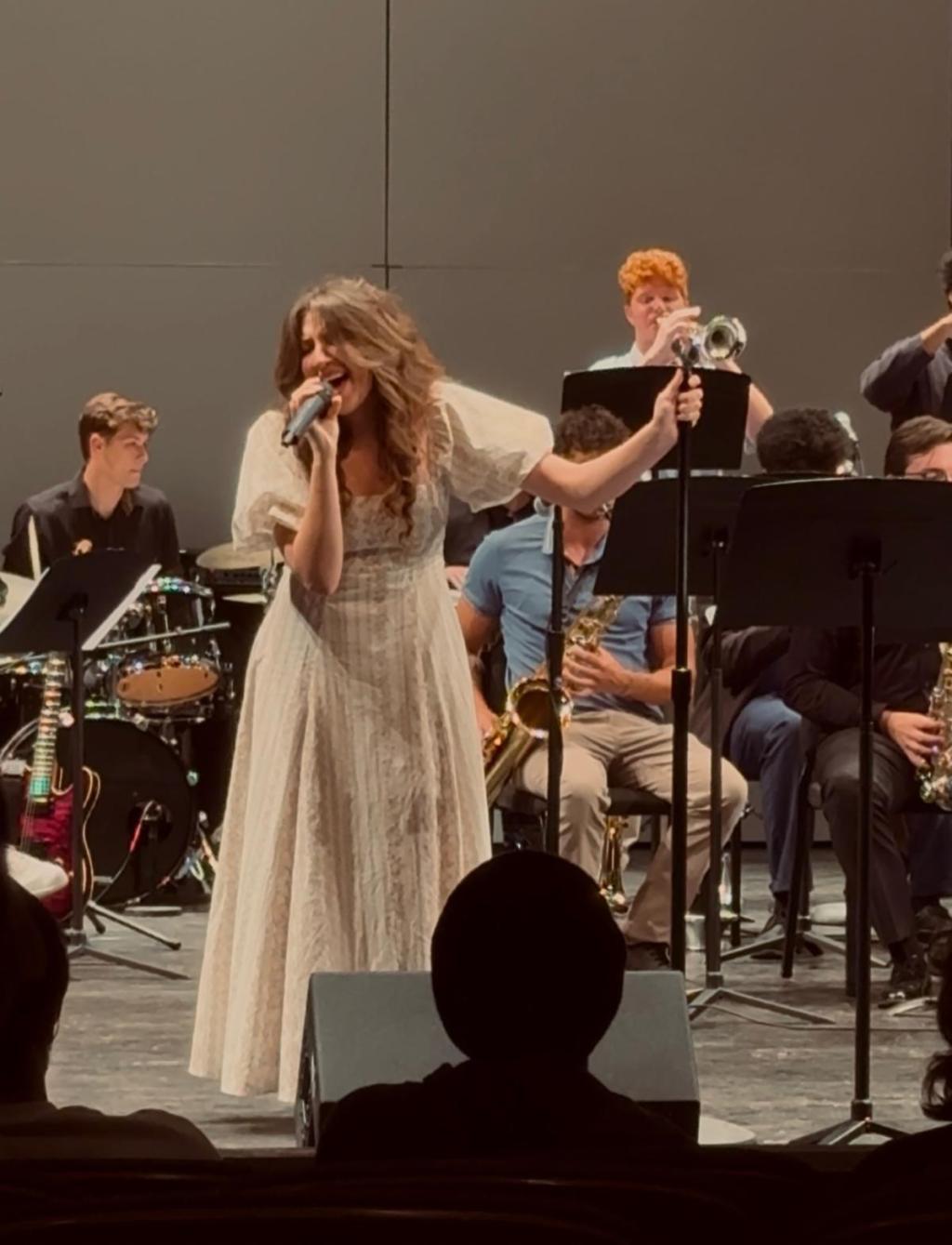
| Submitted Photo: Emma Guillory |
| By Lauren Fernandez Contributing Writer “Every piece that I’ve ever performed is a piece that I wanted to do, and I wanted to do it for a reason,” states Emma Guillory, a young artist and McNeese student. She’s recounting the time she performed for the Pioneer Club at Chase Bank. We’re sitting crisscross on her tidy bed; her bedroom is adorned with warm colors, and her shelves are filled with notebooks and poetry collections. That night, she sang “Smile.” “‘Smile though your heart is aching, smile even though it’s breaking…’ There’s a lot of purpose in those lyrics,” she says. When it comes to vocal performance, even something as seemingly small as body language or the direction that the eyes are facing is all thought out in advance. She starts singing it softly, and then, on the second round, her voice sounds more distressed, more desperate, louder; it carries “a bit more heartache.” This is all intentional. All that stress and passion build up with the music. All of those moments and emotions are let out through the performance. She describes it as an intense physical experience, the body naturally taking over; In that moment, “you don’t have to think about anything else.” Emma believes that singers pick pieces that they have a connection with. “For me, that’s why I loved performing,” she shares. Whatever pain, whatever happiness, whatever love she’s feeling in that moment is an experience she gets to share with the crowd. People have come up to her before and expressed that they teared up in some parts, and this is especially meaningful for her, not just because they thought it was good on a technical level, but because they truly understood her message. Along with the connection she had with her audience, she also describes her time working with other artists very fondly. She pointed to an instance on “Into the Woods,” a performance that was more theatrical. In this scene, with her as Cinderella and her friend Ciara as Little Red Riding Hood, her character had to console Little Red Riding Hood, who had just lost her mother. It was a complex scene, since Cinderella was stepping in as almost a mother figure to comfort her. Everything was meticulously planned to convey an experience to the audience. In these instances of vulnerability and creativity, “Not only are you collaborating with your partner,” she says, “[But] also the message that you’re trying to carry out within the song.” She had a strong connection with singing; it was her preferred method of emotional expression. During her sophomore year in her vocal performance degree, she decided to switch her major. “It wasn’t an easy decision. I do miss it.” She said. “I was writing a lot at the time… I had been thinking about changing my major. I had people tell me, ‘You have a knack for writing and if you do change your major, it needs to be changed to writing.’ There was something about somebody saying, ‘This is the thing for you,’ I think it was that certainty; someone being so certain about this thing about me.” Many other factors made this option seem like it was for her: Her love of plays, her drive to improve her writing technique, and the work of influential writers such as Emily Dickinson and Sylvia Plath inspired her to pursue this new direction. Despite this change, writing doesn’t serve the same function for her as music performance did. Performance for her was this intense self-expression that connected her with others, and writing was a quieter emotional outlet to “get something out of [her] head and onto the paper and keep it there, kind oflike in a cage, and just put it away.” Her writing started as journaling and gradually formed into poetry. After she joined the Blank Page writing group, she was exposed to her other peers’ work. So, she is currently an English major with a concentration in Literature and a minor in Writing, but this is not the destination. “Writing wasn’t something I expressed myself with. It was more of something I could keep hidden.” At this point in her life, Emma used creative writing as a tool to process emotions in a personal manner. “That’s why I’m getting out of this writing habit. I don’t need to do that anymore.” Her writing didn’t have an audience in mind. She believes the next step for her, if she wants to continue writing, is to figure out a way to make writing less of a tool and more of a form of self-expression. For now, she believes it’s time to go in a new direction. “It took me a while, but at least now I have an idea of where I want to go.” Emma’s main goal is to look for something that will genuinely make her happy later in life. “Even if it doesn’t give me this giant income, at least I’m gonna love what I’m doing.” She’s looking to change her major to Animal Science or Biology. She has a soft spot for nature and loves to learn about thosesubjects. She’s currently taking a biology class, and she speaks highly of it. Even though she is forgiving with herself about her academic journey, she expresses that she does feel the pressure of hurrying to find her path. “I keep trying to remind myself that everyone has their own pace, but it can be hard… It’s time to get going.” She’s entered a phase in her life where she wants to move forward and not only advance career-wise, but also to grow as a person. Emma’s academic journey pairs nicely with her description of writer’s block; She’s hitting a wall, and rather than forcing herself through, worrying about what’s on the other side, she’s going to really get to know the outer side and maybe that’ll teach her something that makes it easier to get over the wall. After she shared her story, the notebooks around her room carry a different weight, each little cage. |



Leave a Reply